
Playing Rules 2026/27
The St. Louis Youth Soccer Association (SLYSA) is committed to promoting a safe, fair, and enjoyable soccer experience for all participants. As part of the world’s most widely played sport, SLYSA follows the internationally recognized Laws of the Game, ensuring consistency and integrity across all levels of competition.
Fair play is a core value within SLYSA. The Laws of the Game provide the framework that allows matches to be conducted fairly while preserving the spirit and traditions of soccer. The best competitions are those in which players demonstrate respect for their opponents, coaches, officials, and the rules, allowing the game to flow naturally with minimal intervention from referees.
While the Laws of the Game are designed to be clear and consistent, certain situations require interpretation and judgment by match officials. Because no two games are exactly alike, referees may occasionally make decisions that are questioned or debated. Regardless of differing opinions, SLYSA expects all players, coaches, team officials, and spectators to respect the authority of referees and accept their decisions in a professional manner.
Not every circumstance that arises during a match can be specifically addressed in the Laws. In those instances, SLYSA relies on its officials to apply sound judgment that reflects both the intent of the Laws and the spirit of fair competition.
Player safety remains one of SLYSA’s highest priorities. The organization continually supports policies, procedures, and enforcement measures that help create a safe environment for all participants. While soccer is a physical sport and injuries cannot be completely eliminated, the Laws of the Game are intended to reduce unnecessary risks and encourage responsible play.
SLYSA expects referees to take appropriate disciplinary action when players engage in reckless, dangerous, or unsporting behavior. Actions that endanger the safety of opponents, involve excessive force, or otherwise violate the principles of fair play are not tolerated. Through consistent application of the Laws, SLYSA strives to foster an environment where competition, sportsmanship, and player welfare are equally valued.
MENU - SCROLL DOWN TO VISIT EACH SECTION
SECTION 1. ADMINISTRATION & AUTHORITY
SECTION 2. ROSTER / TEAM ELIGIBILITY
SECTION 3. GAME FORMATS AND SPECS
SECTION 4. PLAYER EQUIPMENT
SECTION 5. SCHEDULING & MATCH MANAGEMENT
SECTION 6. FIELD SAFETY AND GAME CAMERA POLICY
SECTION 7. REFEREES
SECTION 8. TEAM RANKINGS, BRACKETING & STANDINGS
SECTION 9. BILLING & FINANCIAL POLICIES
SECTION 1. ADMINISTRATION & AUTHORITY
1.01 Governing Rules
SLYSA leagues operate under the rules established by:
- United States Youth Soccer (USYS)
- United States Soccer Federation (USSF)
- Fédération Internationale de Football Association (FIFA)
- Missouri Youth Soccer (MYSA) and Illinois Youth Soccer (IYSA)
These rules apply except where specifically modified by SLYSA league rules and approved Operating Procedures.
1.02 League Administration
The League shall:
- Establish deadlines for application and registration
- Determine team qualification and acceptance into divisions
- Oversee league structure and scheduling
The Executive Director has final authority in all league matters, including:
- Rule interpretation
- Discipline decisions
- Procedural adjustments
- Resolution of situations not explicitly covered in these rules
1.03 Operating Procedures
Each SLYSA division shall maintain approved Operating Procedures, which may include:
- Qualification criteria
- League format
- Division-specific procedures
1.04 Player, Coach & Roster Compliance
- All players must be listed on an official, valid state roster to participate
- All coaches:
- Must have a valid Coaches license
- Be concussion certified (training completed)
- Be safe Sport certified
- Must pass a current background check
- Coaches under age 18 must:
- Be designated as “Minor” in place of a Coach ID number
- Have all necessary credentials
At all games, teams must have:
- Valid player passes for all players, coaches, and managers (if on the bench)
- A valid roster (digital copies permitted)
Failure to provide proper documentation may result in forfeiture.
1.05 Match Documentation & Game Requirements
The listed home team must:
- Provide an official GotSport SLYSA event game card to the referee
- The away team should bring a backup game card
Game cards must include:
- Player names
- Jersey numbers
- Player ID numbers
Guest Players
Must be listed on the SLYSA Guest Player Form
- Must have a valid player pass
Incomplete documentation may result in:
- Player ineligibility
- Match forfeiture
1.06 Discipline, Ethics & Conduct
All participants (players, coaches, managers, referees, team officials, and spectators) are subject to SLYSA discipline policies.
Key Conduct Rules:
- Red cards: Initial suspensions are not appealable
- No wagering of any kind (violations may result in expulsion and reporting to state associations)
- No player compensation or promises of payment
- No alcohol, smoking, or vaping in player/coach areas
All individuals must comply with league conduct standards at all times.
More information on SLYSA's Discipline Policy - Click Here
1.07 Responsibilities & Compliance
- Coaches and managers are responsible for ensuring that:
- Players, parents, and spectators understand league rules
- All SLYSA policies, bylaws, and discipline procedures are followed
1.08 Facilities & Local Regulations
All teams must follow and respect the facility rules and regulations at match locations
1.09 Rule Gaps & Amendments
- Any matters not addressed in these rules shall be determined by the SLYSA Board of Directors
- The Board retains the right to:
- Interpret rules at their discretion
- Modify rules at its discretion
SECTION 2. ROSTER / TEAM ELIGIBILITY
2.01 Registration & Governing Requirements
- All teams, players, and team officials must be properly registered through their respective State Associations and one of the following:
- United States Youth Soccer (USYS)
- US Club Soccer
- All player registration must be completed prior to the first league match
- Each team must upload and maintain a current Official State Roster into their application
- Any roster changes require an updated roster upload
Failure to comply may result in forfeiture of matches.
2.02 Team Eligibility
- Any properly registered team may apply for entry into the SLYSA league
Returning Teams:
- Must retain at least 51% from the previous seasonal year roster for history
- Failure to meet this requirement results in classification as a New Team
New Teams:
- Must meet eligibility standards outlined in SLYSA Operating Procedures
2.03 Team Movement, Transfers & Mergers
Club Transfers:
- A team moving from one club to another during the seasonal year may be:
- Renamed within the league once notified by the new team and club
- Team history may be retained if:
- At least 51% of the roster remains intact
- The same system/login is used
Contested Team Status:
- If multiple clubs claim returning team status:
- The League scheduler will determine eligibility (based on retained history in account)
- Supporting documentation may be required
2.04 Application, Acceptance & Final Authority
- Applications must be submitted by League deadlines
- Submission implies agreement to:
- All SLYSA rules, policies, and fees
Team Acceptance:
- Acceptance is determined by the teams billing status and Board of Directors approval if needed
- Teams are not automatically accepted based on registration
Final Authority:
The League has the right to deny entry based on:
- Failure to meet league requirements
- Non-payment of fees or fines
- Prior non-compliance or misconduct
2.05 Player & Team Official Eligibility
- The Official State Roster is the primary document
- All players must:
- Be properly registered for the current seasonal year
- Have a valid player pass (physical or digital)
- All team officials must:
- Be properly registered and rostered
- Have valid credentials and passes
NO PASS = NO PARTICIPATION = NO EXCEPTION
2.06 Roster Structure & Limits
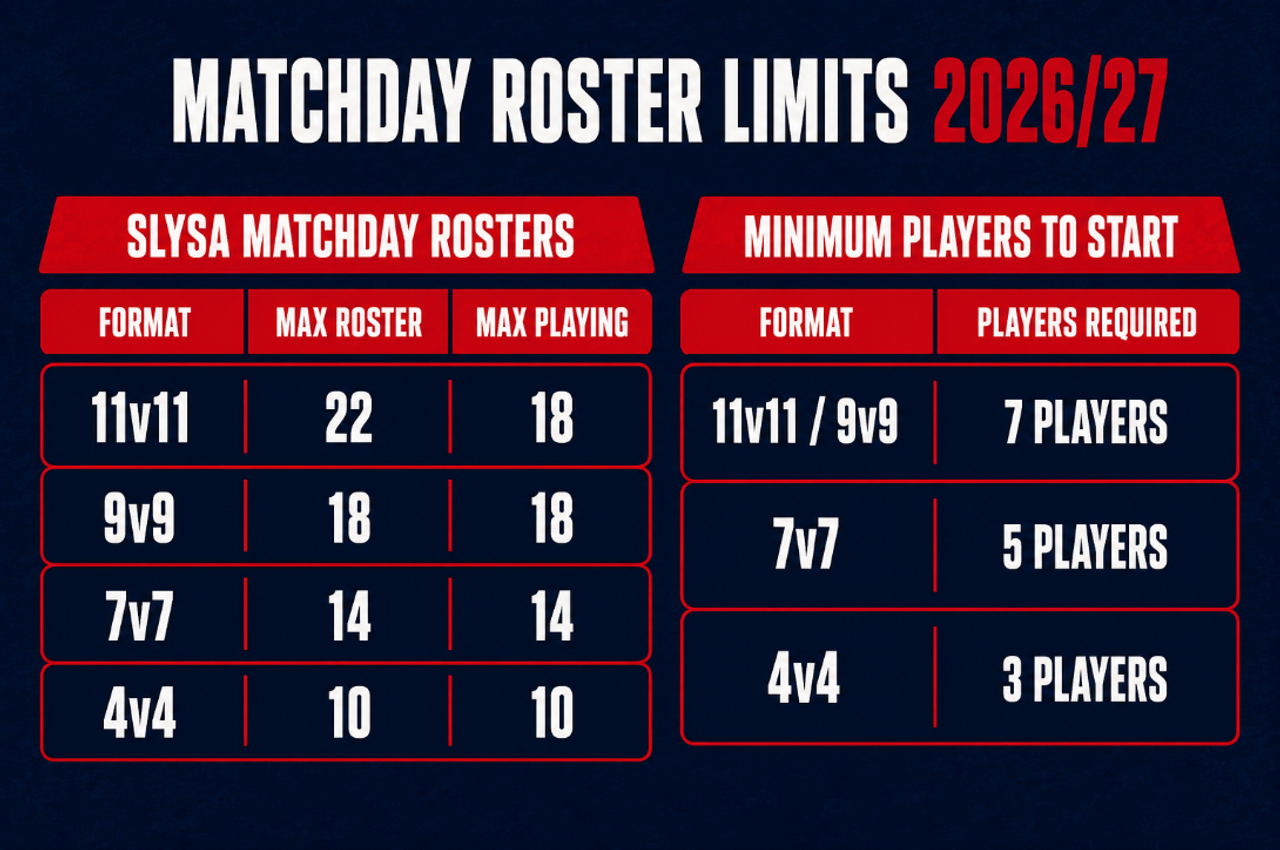
A grace period of up to 15 minutes will be allowed before forfeiture.
2.07 Player Participation Rules
- Players may:
- Play in up to two (2) matches per day
- Be rostered on up to two teams (Primary/Secondary)
2.08 Secondary & Dual Rostering
- Players may be dual rostered (primary + secondary) if:
- Approved through the official registration system
- Primary team/club grants permission
- Secondary players:
- Count toward roster limits
- Can play up or down in SLYSA divisions
2.09 Guest Player Rules
General Rules:
- Must be from the same club and same governing body (USYS or US Club)
- Must have a valid player pass
- Must have a completed SLYSA Guest Player Form
Limits:
- U11–U19 → Max 6 guest players
- U6–U10 → Max 3 guest players
Restrictions:
- No guest playing “down” in a younger age group or in Division level. (Players may guest play within the same division)
- Any players in National or Regional leagues may only guest play to PREMIER DIVISION teams of SLYSA.
- Players may only guest play from their primary roster
Trapped Player Exception:
- If a player is in 8th grade or 12th grade and the remainder of their team has moved on to HS or college, MYSA and IYSA consider them a “trapped player”, meaning they do not have a team to play with for part of the season.
- Limited to 6 players per team and must play as a guest player
- Only allowed in designated divisions (U14/U15 or U18/U19)
2.10 Matchday Requirements
- Teams must provide:
- Player/coach passes
- Completed game card
- SLYSA Guest player form if player is not listed on Official State Roster
- Home team
- Responsible for match card
- Verify score and sign game card post-match
- Away team:
- Should bring a backup match card
- Verify participation and sign game card post-match
2.11 Bench & Sideline Rules
- Minimum 1 and Maximum 4 team officials on the bench
- Only fully credentialed individuals allowed in bench area
- Non-rostered players may not sit on the bench
Coaching:
- Coaching must occur within the designated technical area
- Must have at minimum a Grassroots License
Spectators:
- Must remain on the opposite side of the field
- Coaches are responsible for spectator behavior
2.12 Substitutions & Player Safety
- Unlimited substitutions allowed at referee discretion
- Substitutions permitted during standard stoppages
Mandatory Substitution Situations:
- Injury/blood protocol
- Yellow/Red card (if required by referee)
Safety Rules:
- Bleeding must be stopped before return
- Contaminated equipment must be cleaned/replaced
- Concussion protocols must be followed
SLYSA is not responsible for team documents for other leagues/tournaments.
SECTION 3. GAME FORMATS AND SPECS
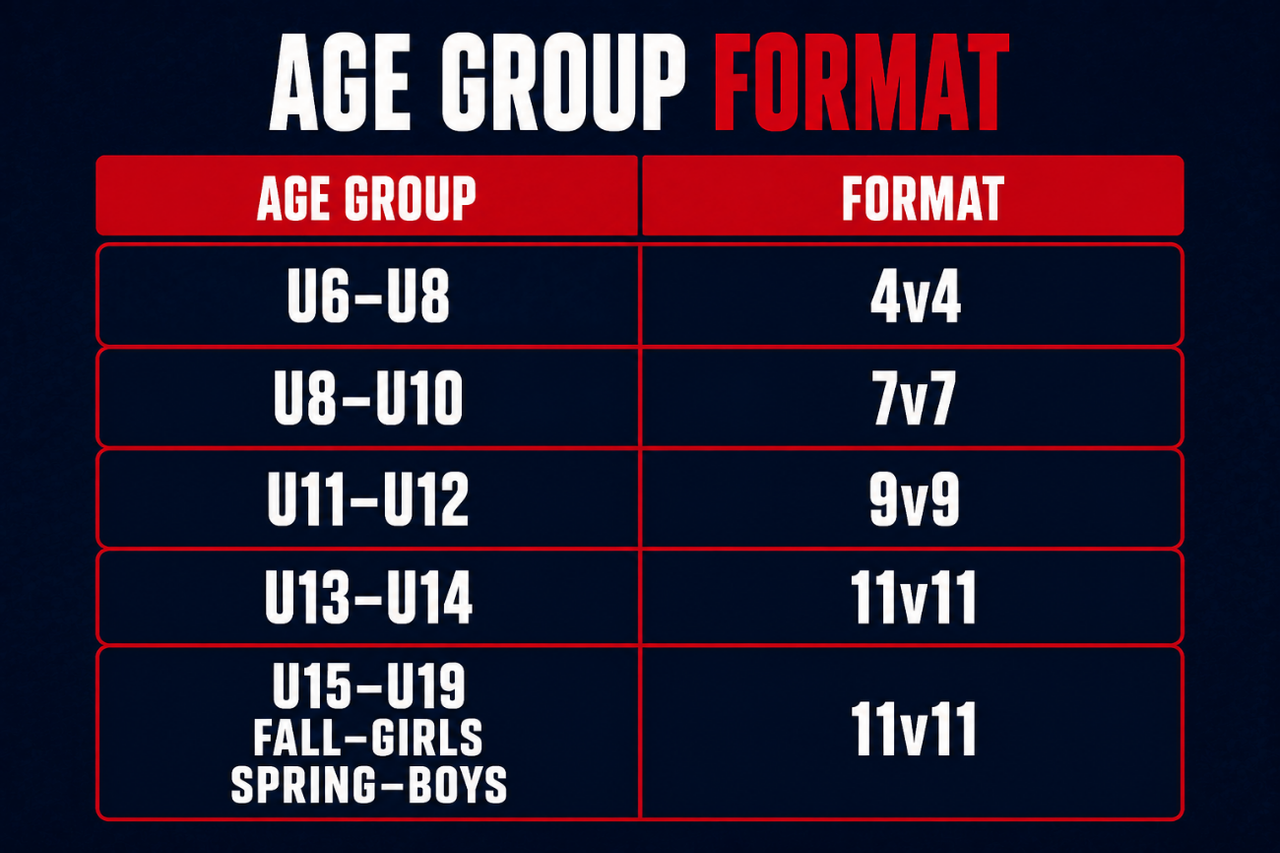
3.01 Age Group Formats
SLYSA offers the following age groups and formats:
3.02 Match Duration
Match Length by Age Group:
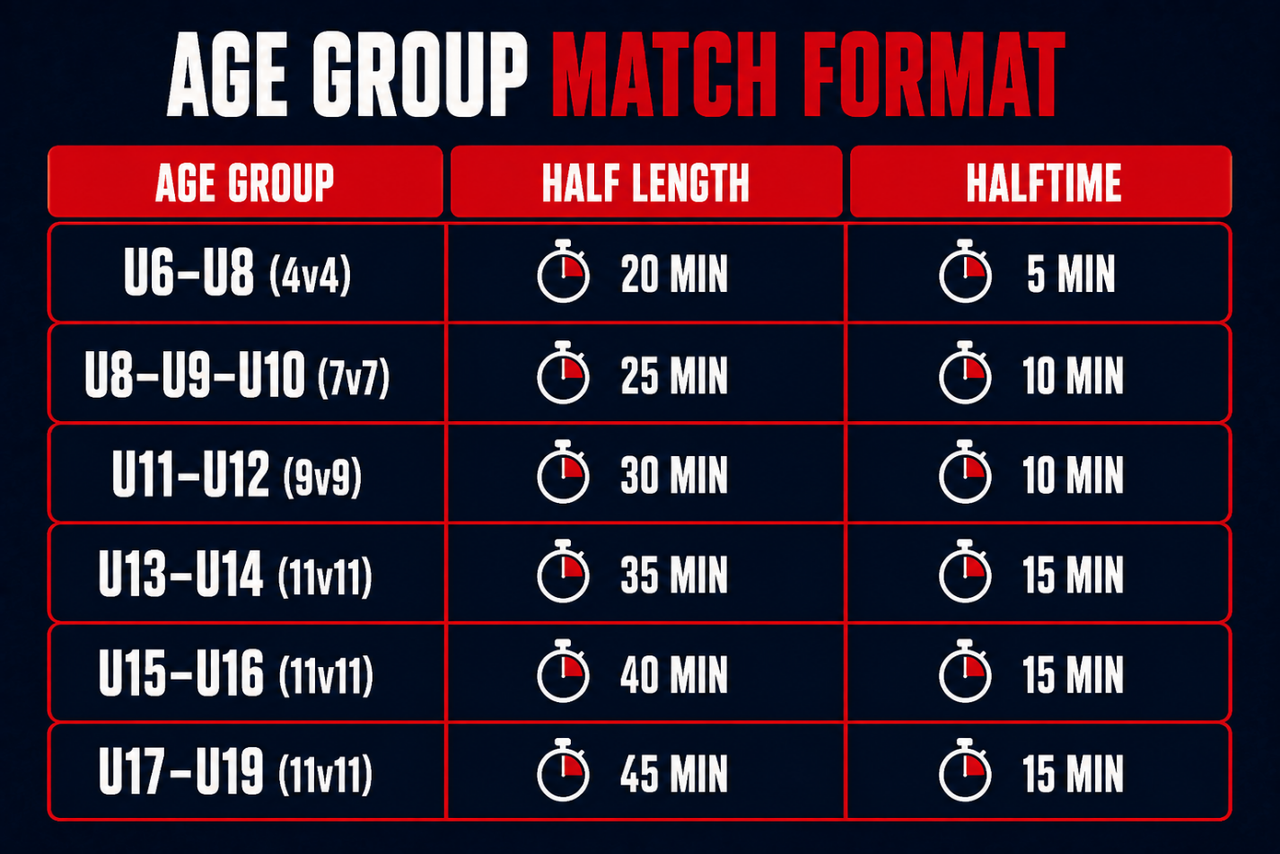
The League may adjust match length in exceptional situations
Matches tied at the end of regulation remain tied
3.03 Match Completion
- A match is considered official after one half is completed (if cancelled for any reason)
3.04 Ball Specifications
Ball Sizes:
- U6–U8 → Size 3 or 4
- U9–U12 → Size 4
- U13–U19 → Size 5
3.05 Small-Sided Game Rules
4v4 (U6–U8)
- No goalkeeper
- No offside
- Kick-ins or dribble-ins (no throw-ins)
- Minimum players: 3
- “No goal zone” enforced (no goal camping)
- A goal may not be scored directly from a kickoff.
7v7 (U8-U9–U10)
- No offside
- Throw ins - two attempts are allowed at referee discretion
- Build-out line is used:
- Opponents must retreat behind the line on goal kicks
- No punting or drop kicks by goalkeeper
- Minimum players: 5
9v9 (U11–U12)
- Offside rule applies
- Standard goalkeeper rules
- No head balls at U11
- Minimum players: 7
11v11 (U13–U19)
- Played in accordance with the Laws of the Game by FIFA
- Minimum players: 7
3.06 Substitutions
- Unlimited substitutions allowed at referee discretion
- Substitutions permitted during standard stoppages
3.07 Timing & Game Management
- The referee controls match time. While SLYSA uses a running clock, additional time may be added for significant stoppages during play.
- Halves may be split into quarters in extreme heat conditions (to allow for water breaks – see Weather guidelines)
- A penalty kick will be allowed to conclude even if time expires
3.08 General Playing Authority
- All matches are governed by the Laws of the Game as defined by FIFA
- SLYSA modifications (small-sided rules, safety policies, etc.) take precedence where applicable
- The referee has final authority on:
- Match decisions
- Rule enforcement (with SLYSA administration guidance)
- Player safety
SECTION 4. PLAYER EQUIPMENT
4.01 General Safety Requirements
- Players must not wear or use any equipment that is dangerous to themselves or others during a match
- Jewelry is not permitted, even if taped
- Exceptions:
- Medical alert items may be worn if taped and visible
The referee has final authority on all equipment safety decisions.
4.02 Required Player Apparel and Equipment
All players must wear the following:
- Jersey with numbers on the back, shorts, socks
- Shin guards:
- Must be fully covered by socks
- Must be made of appropriate protective material
4.03 Footwear
- Cleats must be soccer-appropriate
- The following are not allowed:
- Metal spikes
- Detachable spikes
- Baseball/softball/football cleats
Players without proper equipment will not be allowed to participate.
4.04 Uniform & Number Requirements
- Each player must have a unique jersey number clearly visible on the back (NOTE: THERE IS AN EXCEPTION IN PLACE FOR THIS RULE FOR THE 26/27 SEASON DUE TO AGE CHANGES AND TEAM COMBINATIONS)
- Numbers must be updated on the game card
4.05 Team Uniforms (Kits)
- The home team shall wear white or light-colored jerseys
- If a color conflict occurs while the home team has the designated color the away team must change uniforms
Best Practice:
- Teams should communicate prior to matches to avoid conflicts if unsure of team colors
4.06 Goalkeeper Equipment
- Goalkeepers must wear colors distinct from all players and officials
- Goalkeepers should have a numbered jersey available
4.07 Uniform Logos & Appearance
Permitted on uniforms:
- League or affiliated organization patches
- Club logos
- Sponsor logos
- Player name and number
4.08 Additional Equipment & Braces
Allowed (if safe and unaltered):
- Knee braces (no additional padding required if unaltered)
- Non-metal ankle braces (may be worn outside sock)
- Metal/rigid ankle braces (must be covered by sock)
Restricted or Conditional:
- Hard casts or rigid devices:
- Must be properly padded - allowed at referee discretion
- Doctor’s note recommended but not required
- Finger braces must have exposed metal covered and taped
- Prosthetics - allowed with medical approval
- Must not create danger or unfair advantage
Not Allowed:
- Altered braces outside manufacturer design
- Dangerous or unpadded hard materials
SECTION 5. SCHEDULING & MATCH MANAGEMENT
5.01 Scheduling Authority
- The League Scheduler has final authority over:
- Match scheduling
- Rescheduling decisions
- Scheduled SLYSA matches take precedence over all other events except:
- State Cup competitions (e.g., MYSA/IYSA Cup events)
5.02 Match Start & Grace Period
- Matches should begin at the scheduled time
- A maximum 15-minute grace period is allowed
5.03 Match Completion
A match suspended due to weather or unplayable field conditions before the completion of the first half will be rescheduled; if the first half has been completed, the match shall be considered official.
5.04 Forfeits & Penalties
A forfeit occurs when a team:
- Opponent fails to attend the match
- Lacks minimum players
- Has no licensed coach
- Refuses to play or abandons a match
Forfeit Result:
- Recorded as a 2–0 win for the opponent
Additional Penalties May Include:
- Teams forfeiting three (3) or more matches may be denied entry the following season
- The forfeiting team is responsible for all applicable forfeit fees (due the following business day)
5.05 Rescheduling Policy
- All rescheduling requests must follow the official SLYSA Reschedule Policy
5.06 Sideline & Field Management
- Coaches and substitutes must remain at least 2 yards from the touchline
- Spectators must remain at least 3 yards from the touchline
- Team benches should be located on the same side of the field and confined to a defined technical area
- Spectators must remain on the opposite side of the field from their team
5.07 Roster Verification (Match Check-In)
- Prior to the match:
- Home team to provide match card (Away team bring as back up)
- Provide coach and player passes
- Provide any SLYSA guest player form and ID Cards (if applicable)
- Opposing coaches may request a roster/ID check before kickoff
- Officials are responsible for:
- Verifying player eligibility
- Managing match documentation
5.08 Game Priority & Conflict Responsibility
- Teams are responsible for:
- Managing schedule conflicts
- Communicating with other leagues/tournaments
- SLYSA is not responsible for:
- Conflicts with non-SLYSA competitions
- Rescheduling due to external commitments
5.09 Administrative Authority
- The League scheduler retains authority to:
- Interpret scheduling rules
- Resolve disputes
- Enforce game change fees
SECTION 6. FIELD SAFETY AND GAME CAMERA POLICY
6.01 General Field Safety Responsibility
Prior to each match, referees shall conduct a field and facility safety inspection.
All unsafe conditions should be reported promptly to the field staff, club, and/or SLYSA as appropriate.
6.02 Goal Post Safety
All goals must be inspected prior to use.
Portable Goals
- Be properly secured and anchored at all times while in use
- Have anchoring systems that do not create hazards to participants
- Only be moved by authorized personnel
Permanent Goals
- Be properly secured and anchored
- Have anchoring systems that do not create hazards to participants
Goal Equipment Inspection
Inspect all goals for:
- Sharp edges or corners
- Loose bolts or hardware
- Damaged nets
- Structural defects or instability
6.03 Goal Safety Conduct
Coaches shall:
- Instruct players and parents regarding the dangers of movable soccer goals
- Prohibit horseplay on or around goals
- Remove goal nets when goals are not in use when practical
6.04 Field Surface and Playing Area Safety
Inspect the field and surrounding area for hazards including but not limited to:
- Stones, glass, or foreign objects
- Holes, depressions, uneven surfaces
- Torn or damaged turf/artificial surfaces
- Unsafe sprinkler heads
- Improperly marked drains or drainage systems
- Hazardous equipment left from other sports/activities
Unsafe field conditions shall be reported promptly to the field staff, club, and/or SLYSA as appropriate.
6.05 Sideline and Spectator Area Safety
Ensure:
- A minimum 3 yards from the touchline remains clear of obstructions except for coaches/team officials a minimum of 2 yards from touchline
- Fencing is safe and free from hazards
- Spectators are warned against climbing fences
- Bleachers are inspected for safety prior to use
6.06 Facility Safety
Any hazardous conditions should be reported immediately to slysa@slysa.org.
GAME CAMERA POLICY
6.07 Permitted Use of Cameras
Video recording equipment, including automated camera systems (e.g., Veo), is permitted for team-use purposes only.
All cameras/recording devices must be operated at all times by:
- A licensed coach positioned behind that team’s bench area; or
- A parent/designated adult positioned on the official spectator sideline
Cameras may not be left unattended at any time.
Body Cameras and Recording Devices Prohibited
The use of body cameras, wearable recording devices, or any other audio/video recording equipment worn on a person is strictly prohibited by anyone participating on or within the field of play. This prohibition includes, but is not limited to, referees, assistant referees, players, coaches, team officials, and any other individual entering the field of play or technical areas.
6.08 Camera Placement and Safety
Recording equipment:
- Must not interfere with players, referees, spectators, or match play
- Must be positioned a minimum of 6 feet off the touchline of the field being used and any adjacent field
- Must be placed so as not to create tripping hazards or unsafe conditions
6.09 Restricted Sideline Areas
The center area of each team sideline is reserved exclusively for:
- Referees and other Match Officials
No cameras, tripods, mounts, operators, or equipment may occupy or obstruct this designated area.
6.10 Referee / Facility Authority
Referees, Site Managers, and Facility Management retain full authority to require:
- Repositioning of any camera/equipment/operator; or
- Immediate removal of any recording device from the field area.
Facility-specific policies regarding cameras/video equipment supersede this policy where applicable.
The league assumes no responsibility for, loss, theft, or damages to any recording devices or equipment.
SECTION 7. REFEREES
7.01 Referee Authority and Jurisdiction
- Referees shall have full authority to enforce the IFAB Laws of the Game, SLYSA rules, and all competition modifications.
- Referee jurisdiction begins upon arrival at the field of play and ends when the referee leaves the field and surrounding area.
- Once the referee has jurisdiction, the referee may stop, suspend, abandon, or terminate a match in accordance with IFAB Laws of the Game and SLYSA rules.
7.02 Referee Assignments and Officiating System
- Match officials shall be assigned by a certified USSF Referee Assignor under the authority of SLYSA.
- 9v9 and 11v11 matches should be officiated using the three-person FIFA/USSF Referee System.
- If fewer than three certified officials are available, the referee must appoint Club Assistant Referees.
- Club Assistant Referees may assist only with touchline and possession decisions.
- 4v4 and 7v7 matches should be officiated using the one-person FIFA/USSF Referee System.
7.03 Referee Duties and Responsibilities
Referees shall:
- Enforce all applicable Laws of the Game and SLYSA rules.
- Conduct the pregame conference with coaches and captains.
- Administer the coin toss.
- Serve as official timekeeper.
- Ensure the game ball and field equipment meet legal requirements.
- Verify player equipment compliance before and during play.
- Apply disciplinary sanctions as required.
- Submit all required match documentation following the game.
7.04 Player and Team Official Check-In
- Referees shall verify all players and team officials using the official match roster/match card prior to the match.
- Check all player and coach ID Cards prior to the match.
- The opposing coach may observe the player verification process.
- Late-arriving players must check in with the referee prior to entering the match.
- A player may not participate until properly verified by the referee.
7.05 Match Reports
- The official Match Card/Match Report shall be used for all SLYSA matches.
- Following the match, the referee shall record:
- Final score
- Allow both coaches to sign game card for verification
- Cautions and send-offs
- Any notable match incidents/injuries
- A supplemental referee report must be submitted for:
- Send-offs/ejections
- Referee assault or abuse
- Match abandonment/termination
- Injuries that occurred during game
- Any other extraordinary incidents
7.06 Injuries, Safety, and Match Control
- The referee may stop play for serious injuries and ensure injured players are removed safely.
- Players with bleeding or open wounds must leave the field and may not return until cleared by the referee.
- The referee may suspend or terminate play for unsafe field, weather, spectator, or external conditions.
- The referee may remove or dismiss any player, coach, team official, or spectator.
7.07 Body Cameras and Recording Devices Prohibited
The use of body cameras, wearable recording devices, or any other audio/video recording equipment worn on a person is strictly prohibited by anyone participating on or within the field of play. This prohibition includes, but is not limited to, referees, assistant referees, players, coaches, team officials, and any other individual entering the field of play or technical areas.
SECTION 8. TEAM RANKINGS, BRACKETING & STANDINGS
8.01 League Entry & Team Classification
- Acceptance into SLYSA is at the sole discretion of the SLYSA Board of Directors
- Teams are placed into divisions based on:
- Prior season performance (if applicable)
- Application information
- Bracketing Committee evaluation
Team Ownership:
- Club teams → controlled by the club administrator on file
- Independent teams → controlled by the listed coach/manager
- Ownership may be reassigned with SLYSA approval
8.02 Bracketing Committee & Authority
- The Bracketing Committee is appointed by the Competition Commissioner and approved by the Board
- The Committee has final authority over:
- Team rankings
- Division placement
- Bracketing decisions
The objective is to create the most competitive divisions possible.
8.03 Bracketing Process
- Initial brackets are created by SLYSA League schedulers based on team’s previous season data
- Bracketing Committee reviews and adjusts rankings
- Preliminary brackets are published to all clubs and teams
- Feedback is submitted:
- Club teams → through designated club representative
- Independent teams → directly to SLYSA schedulers
- Committee reviews all requests and finalizes brackets
- Final divisions are published
- Scheduling begins, no further bracket changes are allowed
8.04 Bracketing Criteria & Placement
Team placement is determined using the following factors:
Primary Factors:
- Previous season performance
- Win/loss record
- Division standings
- Team continuity and history
Additional Considerations:
- New teams may be placed in lower divisions unless justified otherwise
- Teams with prior non-SLYSA history may be evaluated for higher bracket placement
- Teams returning after one season may retain placement of previous season
- Teams absent for two or more seasons are treated as new and placement can be reviewed by the bracketing committee for higher placement
Special Rules:
- Teams may request to remain in the same division or move down
- Division winners or high-performing teams are eligible to be promoted
- Low-performing teams may be relegated
Performance Guidelines:
- ≥ .750 win percentage → eligible for promotion
- ≤ .250 win percentage → subject to relegation
Additional Placement Rules:
- Efforts will be made to separate teams from the same club into different divisions
- We may create Blue, Red, and White labeled divisions to split a larger bracket for further history to use the next season for team placement
- Girls may play in boys divisions; boys may not play in girls divisions
8.05 Promotion & Relegation
- Promotion and relegation between divisions are:
- Managed by the League schedulers
- Overseen by the Competition Commissioner
- Final decisions are based on:
- Standings
- Eligibility requirements
- Operating Procedures
8.06 Team Status, Withdrawals & Forfeits
- Teams forfeiting 3 or more matches:
- May be denied entry the following season
- Are responsible for all associated fees (due the following business day)
- Teams withdrawing:
- Will not receive refunds
- May be denied future participation
8.07 Standings & Points System
Standings are determined as follows:
- Win = 3 points
- Tie = 1 point
- Loss = 0 points
Uneven Matches:
If teams play an unequal number of games:
- Standings will be determined using points per game (PPG)
- Calculated as:
- Total points ÷ maximum possible points from games played
- Rounded to three decimal places
Standings become final one (1) week after last scheduled match.
8.08 Tiebreaker Procedures
Two-Team Tiebreaker
- Head-to-head result
- Goal differential
- Goals for
- Most wins
Three-Team Tiebreaker skips head-to-head result.
8.09 Administrative Authority
- The League schedulers and Bracketing Committee retain authority to:
- Interpret standings rules
- Resolve disputes based on prior year seasonal standings/past requests
- Adjust standings in exceptional circumstances
SECTION 9. BILLING & FINANCIAL POLICIES
9.01 League Fees & Payment Requirements
- All teams must pay league fees by the published season due date
- Teams that fail to pay by the deadline:
- Will not receive points for wins or ties during delinquency
- Will resume earning points only after payment is made (note: previously changed points will not revert back)
- All fees and fines must be paid in full by the end of the season
- Participation in the league constitutes acceptance of all financial league obligations
9.02 Delinquent Accounts
- Any unpaid balances at the end of the season will be forwarded to the team’s State Association
- Failure to resolve outstanding balances may affect future participation eligibility.
9.03 Refunds, Credits & Non-Refundable Fees
General Policy:
- League fees are non-refundable unless otherwise stated
- Administrative and Assignor fees are non-refundable
Cancelled Games (In the event a game cannot be rescheduled)
- Credit will be applied toward future league fees
9.04 Fines & Penalties
SLYSA may impose fines for rule violations, including but not limited to:
Offense | Penalty |
Withdrawal from SLYSA after schedule release | $650.00 |
Forfeit of SLYSA match (due following business day) | $170.00 per game |
- All fines must be paid by the stated season deadlines
9.05 Financial Enforcement & Authority
- The League retains authority to:
- Enforce all billing policies
- Determine eligibility based on financial compliance